Open Source · Free for personal use
Local AI agents.
One shared mind.
Your Claude and AI agents run locally. Mindbase gives them a shared memory layer on top. Cross-session, cross-machine, cross-agent.
Your Claude and AI agents run locally. Mindbase gives them a shared memory layer on top. Cross-session, cross-machine, cross-agent.
The problem
You're running multiple Claude instances. Each one is excellent. Each one is completely blind to what the others are building.
The solution
Mindbase sits above all the arms. A shared memory layer every agent reads from and writes to, in real time.
Why I built this
I opened my second machine, fired up Claude, and just sat there.
How do I even begin to explain everything?
I was running Claude Desktop, Claude Code CLI, a Hermes agent, and Openclaw, all simultaneously, across two machines, on four different projects. Each one doing its own thing. Each one completely blind to what the others were building.
Every new session started from zero. I'd spend the first fifteen minutes re-briefing Claude on what happened yesterday, what we decided last week, why we chose this approach over that one. The same context, over and over. It was admin work masquerading as building.
The problem wasn't the agents. They're brilliant. The problem was that each one was a robotic arm, excellent at its task, but completely isolated. One arm didn't know what the other arms were doing. And I was the one manually bridging them, holding all the context in my head, slowly losing my mind.
I needed something that sat above all the arms. A shared memory layer that every agent could read from and write to. So when Claude on my Mac finishes a session, Claude on my Ubuntu server picks up exactly where it left off, without me saying a word.
That's Mindbase. Memory at the mind level, not the arm level.

What you get
One memory layer. All your Claude instances read from it and write to it automatically.
Every decision, every context choice, every why, stored in a structured format so the next session picks up with full knowledge, not a blank slate.
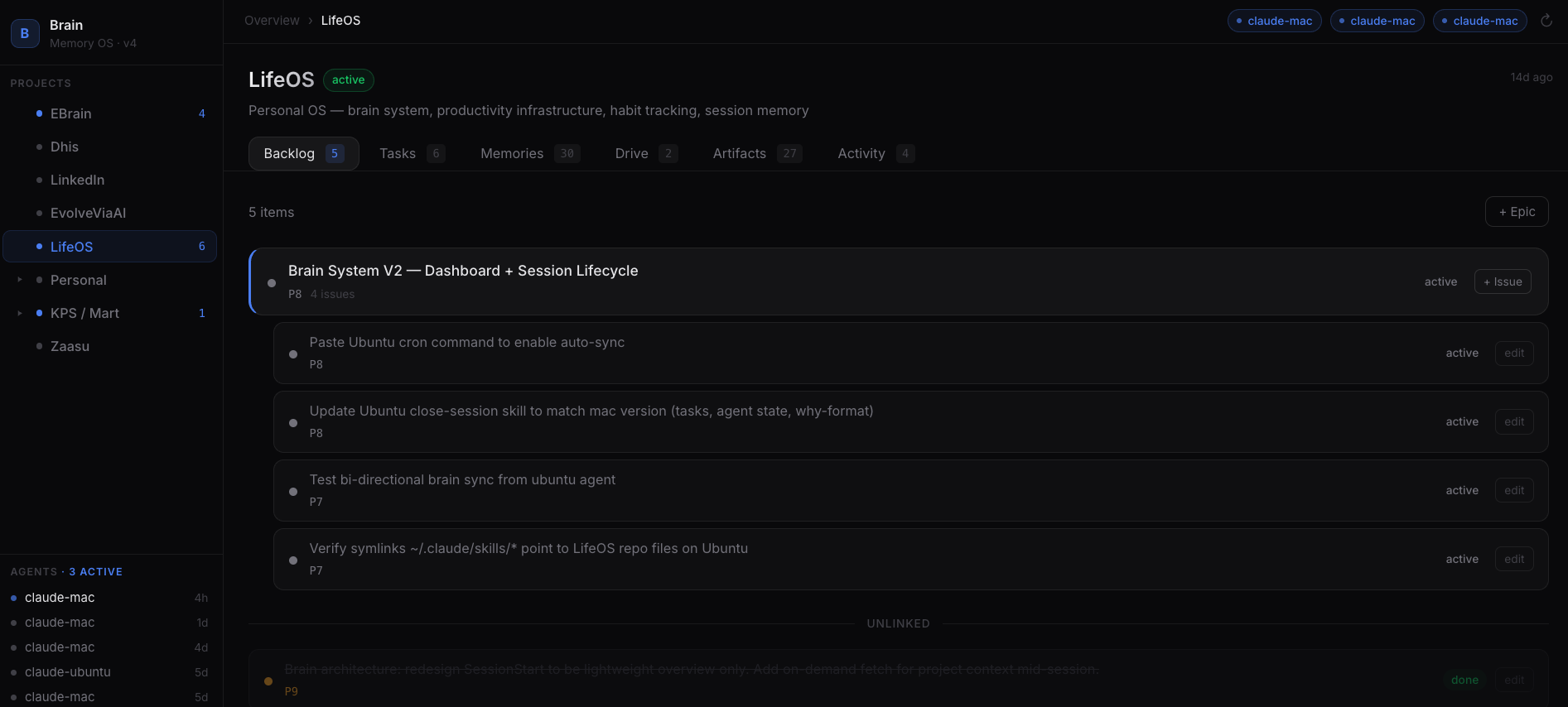
Every running Claude instance registers itself. You see who's working, what they're on, and when they last synced, all from a single dashboard.
Projects, tasks, backlog, memories, and session history, all structured and linked. Claude enforces the session lifecycle automatically at every open and close.
Memories are embedded with Workers AI and stored in pgvector. Semantic search means asking "what did we decide about auth?" returns the right answer, not just keyword matches.
Everything runs on services with generous free tiers. You own the deployment. No subscriptions, no vendor lock-in, no data leaving your control.
How it works
Mindbase writes itself into your ~/.claude/CLAUDE.md during install. Claude does the rest.
npx -p mindbase mindbase-join. Claude asks for your URL and API key. No infra, no accounts, no migrations. Same mind, new machine.